
Salvator merianae
Meet Ursula.
Ursula is an Argentine black & white tegu: intelligent, powerful, food-motivated, and dependent on large, carefully managed daily care.
Search tegu answers →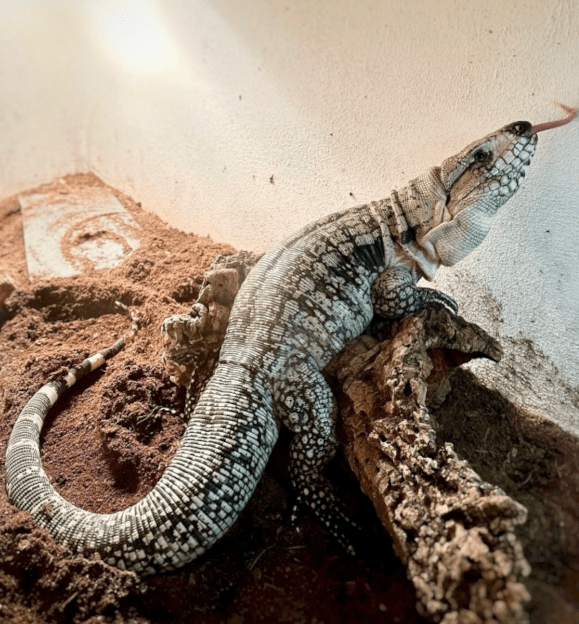
Room to burrow. Heat to thrive.
Adult tegus require a room-scale escape-proof enclosure, a 110–120°F basking surface, a cooler retreat, strong UVB, roughly 70–80% humidity with ventilation, and deep suitable substrate. Their varied diet and supplement plan should be reviewed by an experienced reptile veterinarian.
Enclosure & Climate
Tegus need 8×4-foot or larger enclosures with secure walls, a thermal gradient, humid hides, and 12–14 hours of UVB. Deep substrate allows natural burrowing and shedding.
Diet & Wellness
Omnivorous meals of whole prey, insects, eggs, and produce, plus calcium and vitamin D support, keep growth steady. Annual reptile veterinary exams catch early care-related issues.
Behavior & Handling
Food-motivated and curious, tegus can learn to tolerate calm, consistent handling. Consistent routines and clear enclosure boundaries reduce stress and defensive responses.
Commitment & Safety
Tegus live 15–20 years, grow over 4 feet, and need daily care, strong biosecurity, and local permit checks. Their strength and feeding response demand experienced handling.
Tegu knowledge
Tegu care questions
A friendly, detailed explanation of medication safety and adherence as it applies to argentine tegus.
Argentine Tegus · medication safety and adherenceHow should quarantine work for argentine tegus? →An everyday reference for understanding quarantine and introductions in argentine tegus.
Argentine Tegus · quarantine and introductionsWhat substrate or bedding is safe for argentine tegus? →Make substrate and bedding decisions that fit the body, behavior, and lifetime of argentine tegus.
Argentine Tegus · substrate and beddingWhen does illness in argentine tegus require a veterinarian? →Turn broad health monitoring advice into a workable routine for argentine tegus.
Argentine Tegus · health monitoringHow should food for argentine tegus be stored and prepared? →Build a safer, more realistic food storage and feeder safety plan for argentine tegus.
Argentine Tegus · food storage and feeder safetyHow do I choose an ethical source for argentine tegus? →Build a safer, more realistic ethical sourcing and rescue plan for argentine tegus.
Argentine Tegus · ethical sourcing and rescueWhat should I know before getting argentine tegus? →A closer look at preparation and lifetime responsibility for argentine tegus, including food, habitat, safety, and veterinary planning.
Argentine Tegus · preparation and lifetime responsibilityHow do argentine tegus build trust with caretakers? →Careful, readable guidance on trust and caretaker relationships for people responsible for argentine tegus.
Argentine Tegus · trust and caretaker relationshipsWhat should I bring to the first veterinary visit for argentine tegus? →Build a safer, more realistic the first veterinary visit plan for argentine tegus.
Argentine Tegus · the first veterinary visitHow do I animal-proof a home or habitat for argentine tegus? →Understand what makes home and habitat safety different for argentine tegus and how to plan around it.
Argentine Tegus · home and habitat safety